
I slept much better that night even though I was still awake a couple of times. During the night, we were treated to nature’s fireworks. It looked impressive. I commented to Graham that I was relieved that I was not reacting to this. When we were cruising out of Singapore in 2019, there was a thunderstorm right overhead one evening and this actually made me quite ill. Graham told me that although it definitely looked impressive, it was far out at sea.
We woke up again just before six. We got ready and headed for breakfast. We both had coffee. Graham had some orange juice, and I had some fruit punch. Graham had some fruit, fried egg on toast and some porridge. I had some tinned longans, some congee with fried shallots and onions and a waffle with squirty cream and Nutella. After breakfast, we went back to our room to get ready for the day ahead. Then we headed out.
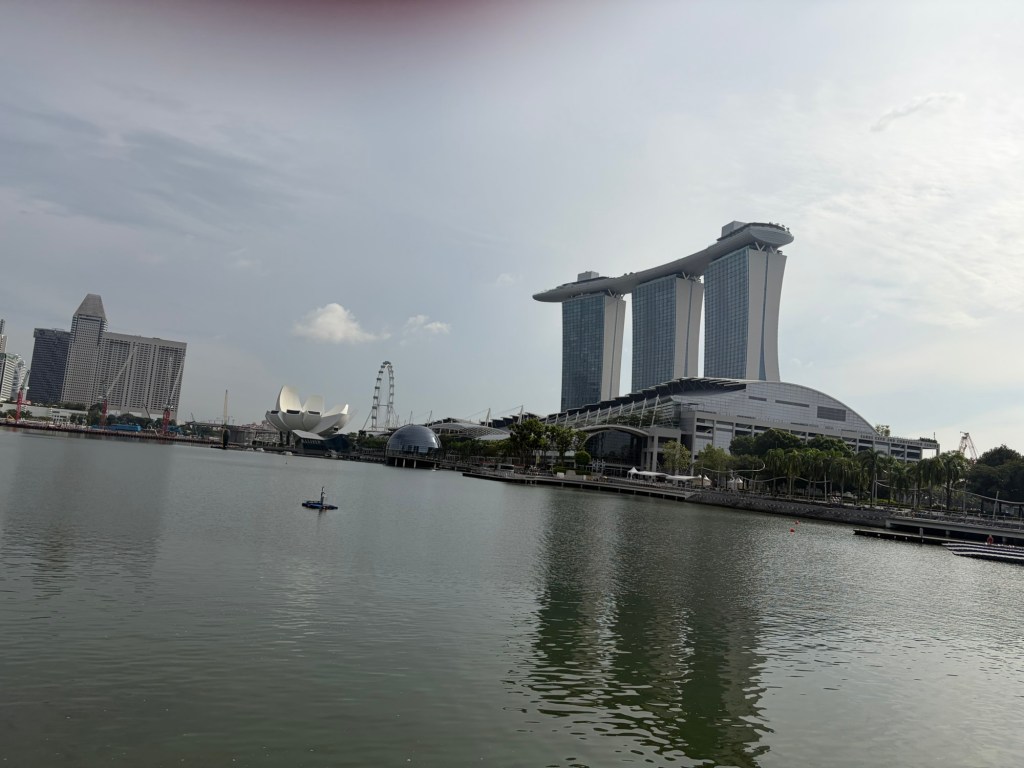
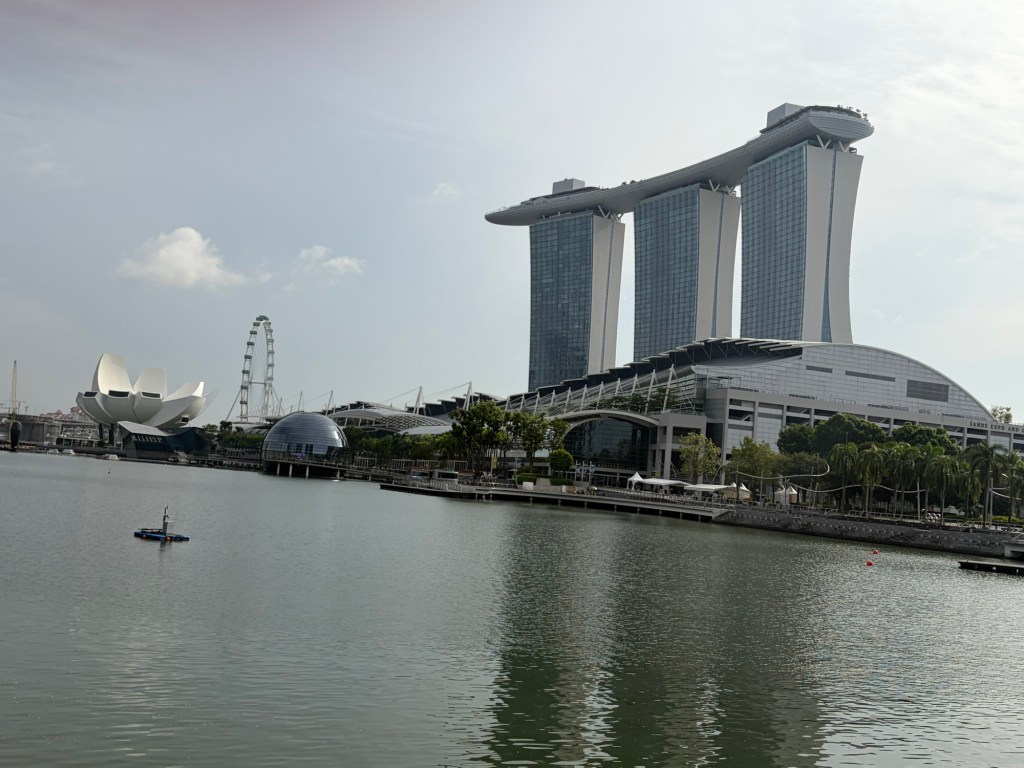
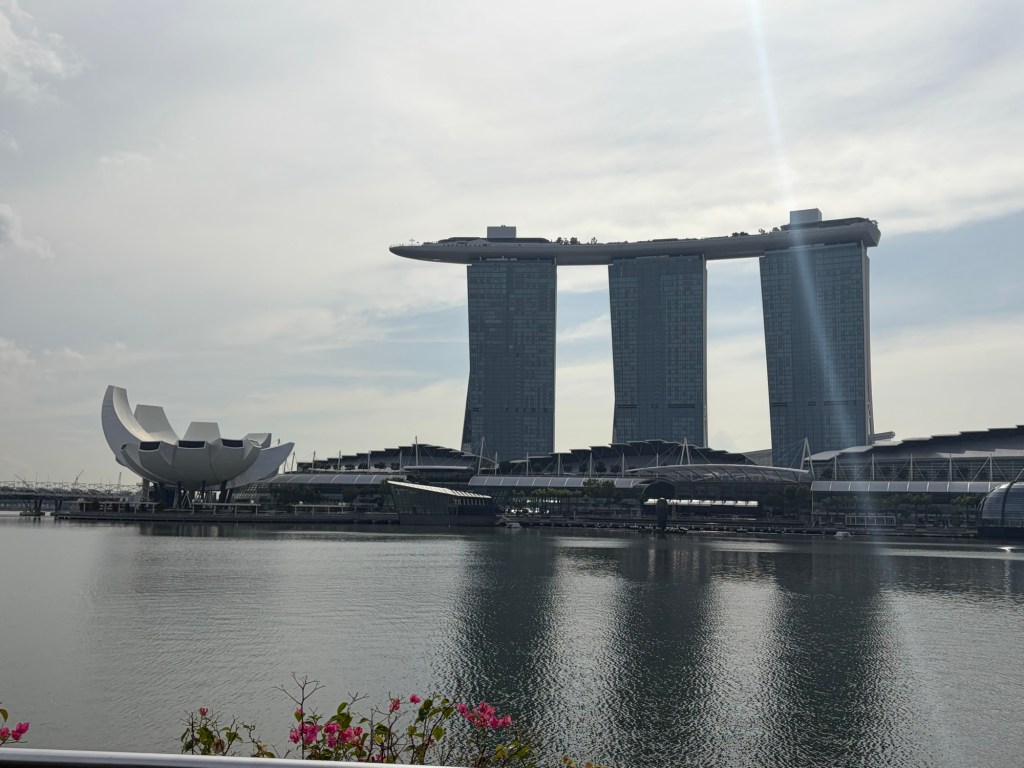
Things looked decidedly gloomy that morning and the weather forecast indicated that there may be some showers about first thing. The quickest route to our first destination was quite exposed to the weather. We decided to take the MRT to Marina Bay and walk from there. We figured there would be more shelter using that route. There was some very light drizzle in the air when we came out of the Marina Bay MRT station, but this soon blew over. Soon after we reached the waterfront, we had clear blue skies. We got our first view of the merlion, which is where we were heading. We also got some rather nice views of the Marina Bay Sands Hotel, the Art Science Museum and the Singapore Flyer. The first part of the walk was quite boring, but most of it was actually very pretty.
Graham wanted to have a quick look at the Fullerton Bay Hotel as we walked past. I was familiar to the Fullerton Hotel, which is located opposite, but the Fullerton Bay Hotel was not on my radar. The Fullerton Bay Hotel is still a relatively new hotel, which opened in 2010. However, it is packed with history. The hotel has integrated two historical landmarks. Clifford Pier was built in 1933 as the landing jetty for ships and marked the arrival point where immigrants began a new chapter of their lives. The pier features Art Deco-style architecture and concrete arches. This area now acts as the lobby of the Fullerton Bay Hotel. The second historical building is the Customs House. The Customs House was home to the harbour division of the Singapore Customs Police in 1969. Today it houses five world-class restaurants, each specialising in different cuisines. We did not check this out. In the main building of the Fullerton Bay Hotel, they had a small area highlighting the history of this area, which was very interesting. I was glad that we made this slight detour.
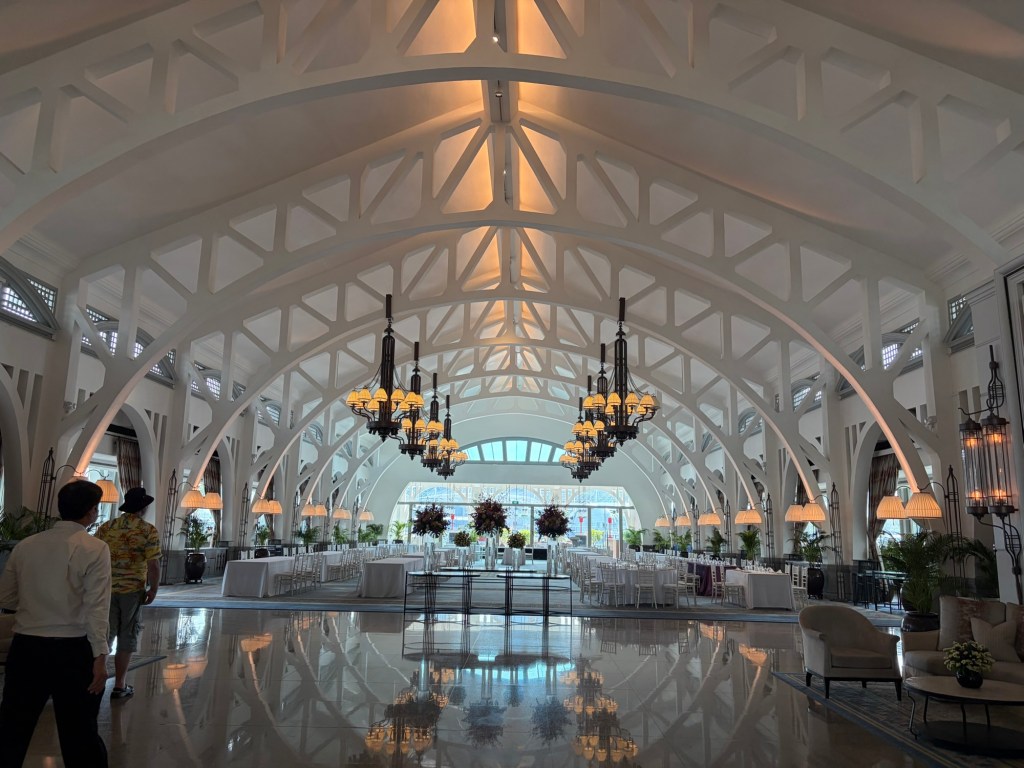
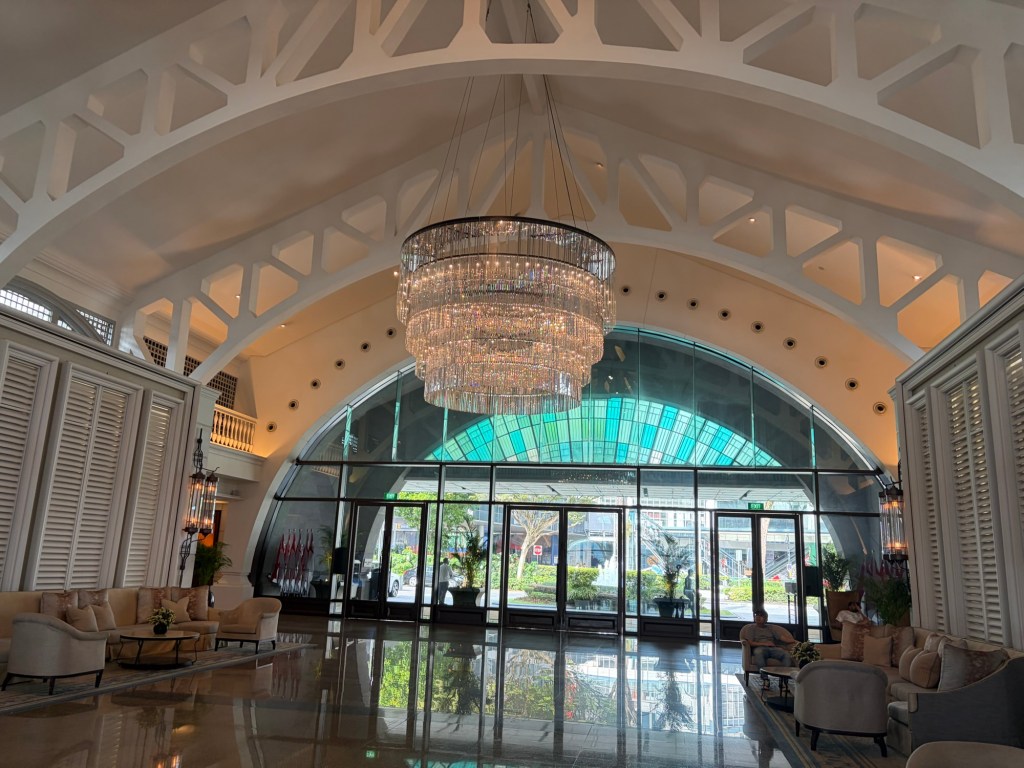
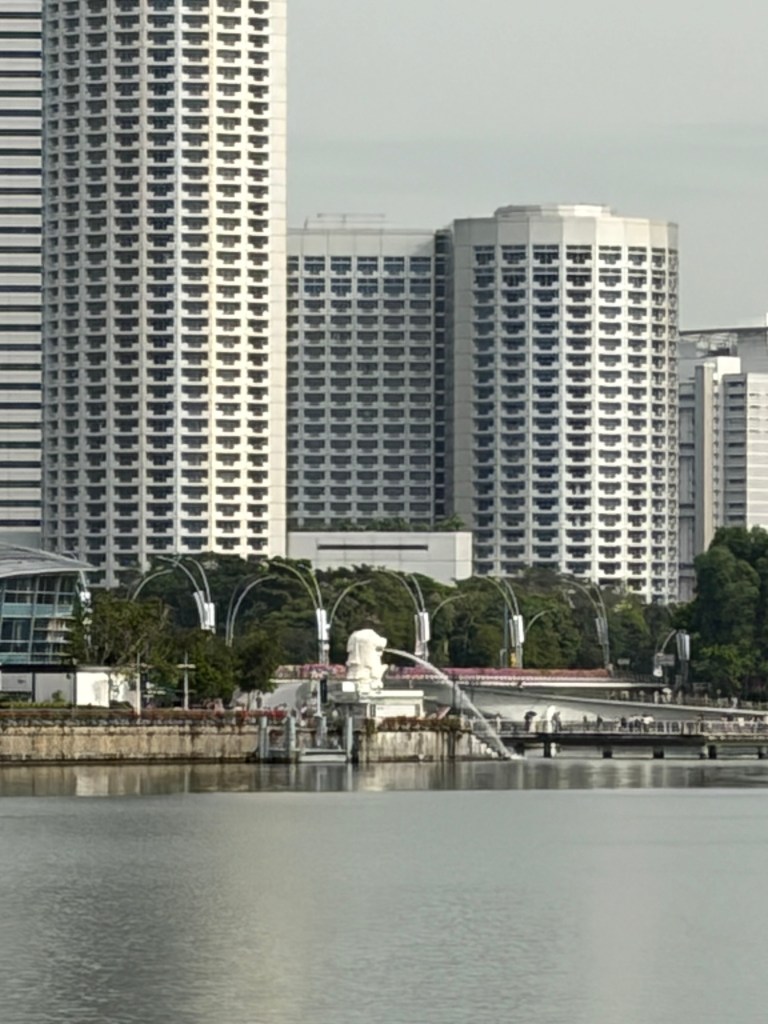
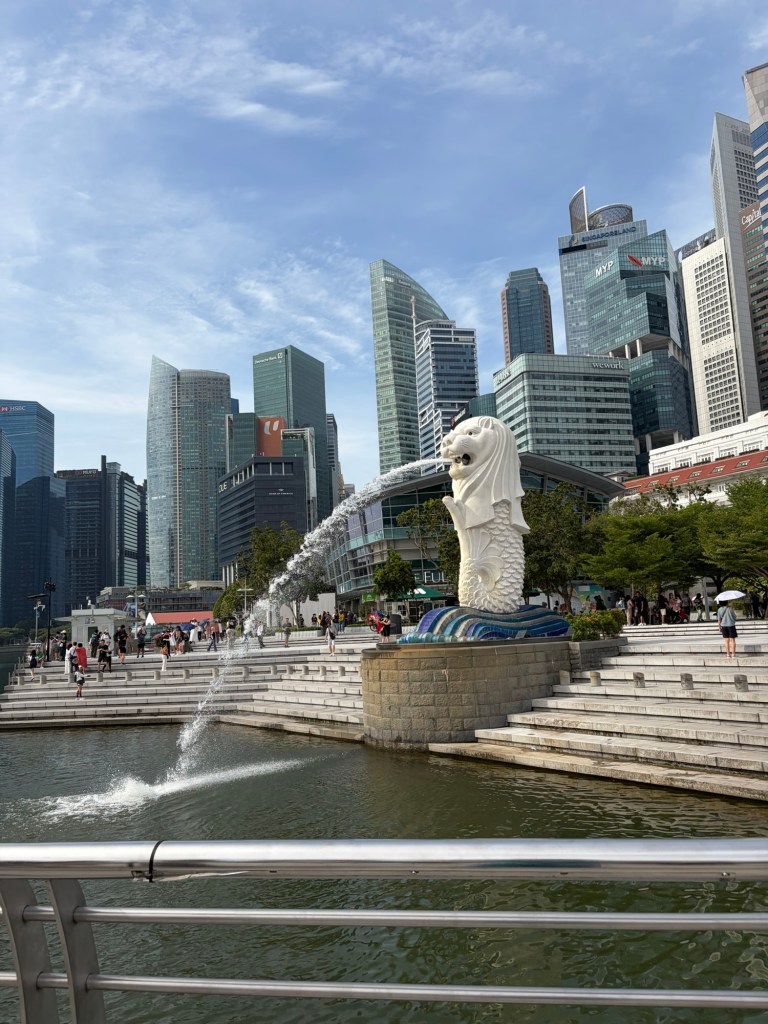
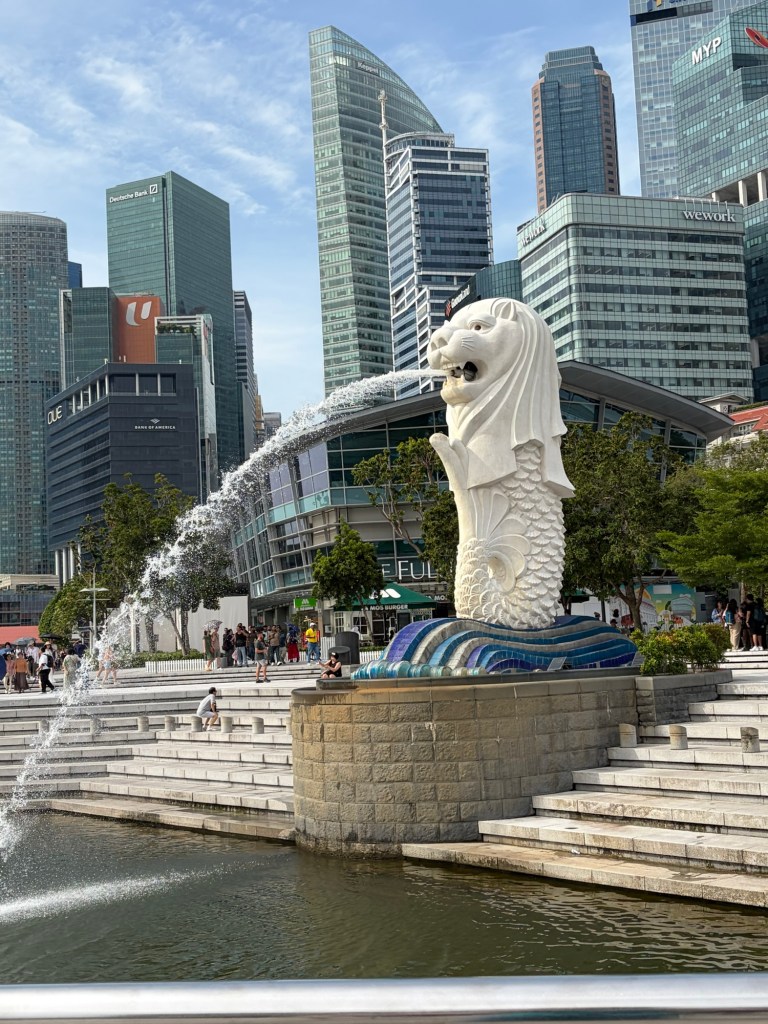
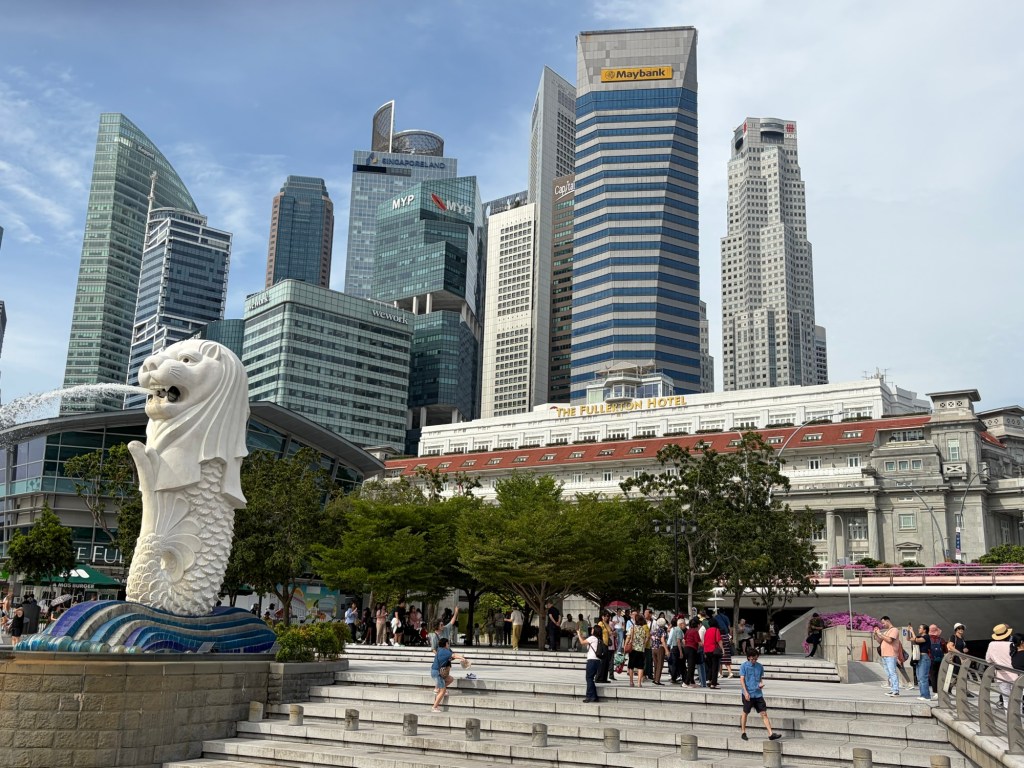
After this, we pushed on to Merlion Park. The merlion, which combines the head of a lion with the tail of a fish is the national symbol of Singapore. Legend has it that Prince Sang Nila Utama – who re-discovered the ancient trading port, Temasek – saw a lion when he arrived at the island. There were never any lions in Singapore. What he most likely saw was a tiger. This incident inspired him to call the island Singapura, which is made up of two Sanskrit words: Singa and Pura, meaning ‘lion’ and ‘city,’ respectively. The merlion was originally designed in the 1960s as a logo for the Singapore tourist board giving a nod to both the name of the city and also to its origins as a fishing village. The first merlion statue was created in the 1970s and was originally placed at the mouth of the Singapore river. When the Esplanade Bridge was completed in 1997, the original Merlion Park location was also no longer the entrance of Singapore River, and the statue could no longer be viewed clearly from the Marina Bay Waterfront. In 2002, the statue was relocated to a new pier specially built on the other side of The Esplanade Bridge adjacent to The Fullerton Hotel. Apart from the original merlion statue, which is right on the waterfront, there is also a smaller statue called the merlion cub, which was created by the same artist that is set a little way back from the waterfront.
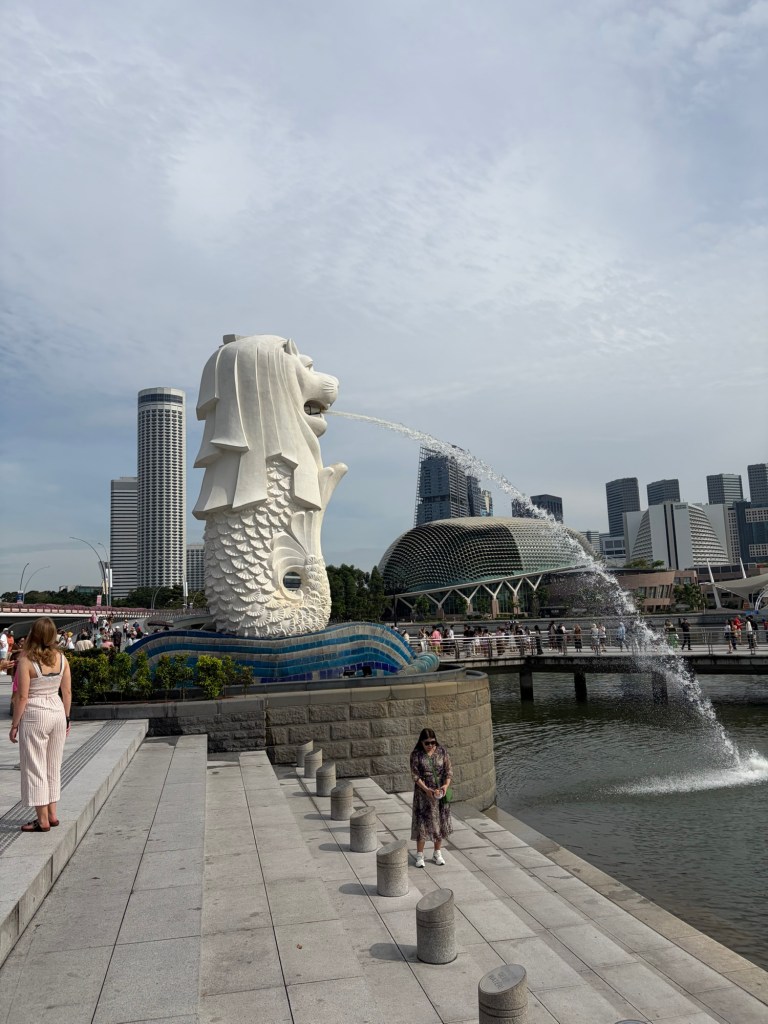
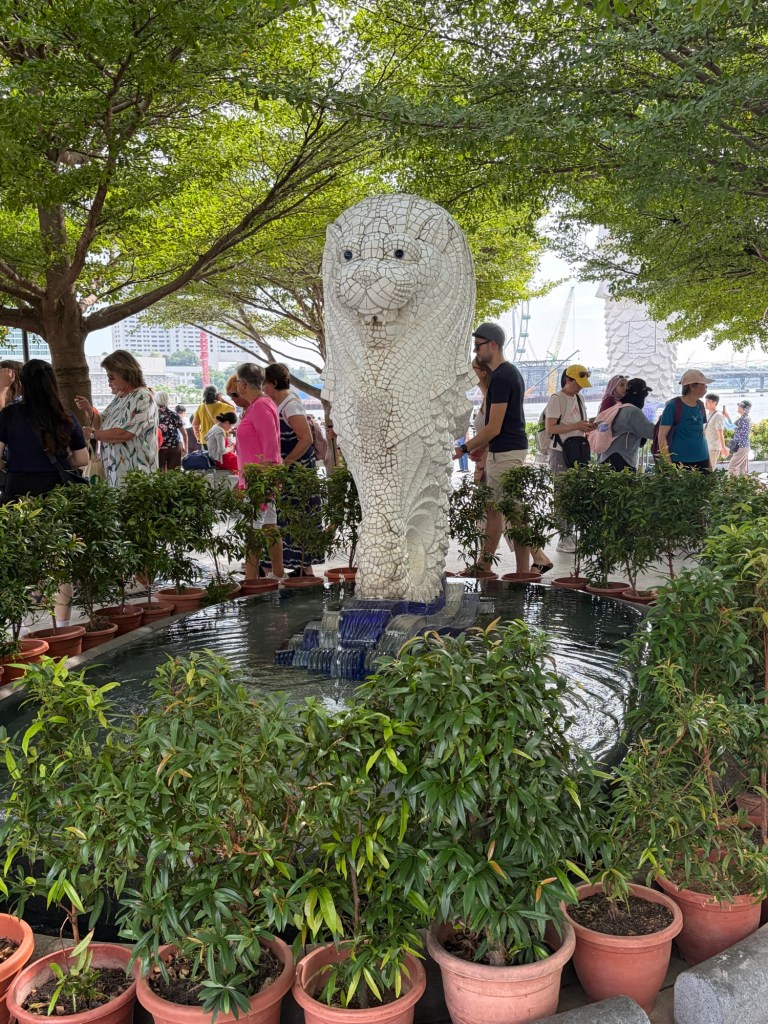
When we had visited Merlion Park in 2019, we had gone there on a Sunday in the late afternoon, and it was crazy busy. I had read that the best time to visit is in the morning and this definitely proved to be the case. There were a few people around, but it was very manageable. I managed to get some photos without having to dodge people. Just as we were getting ready to leave some tour groups arrived. We had definitely timed this perfectly.
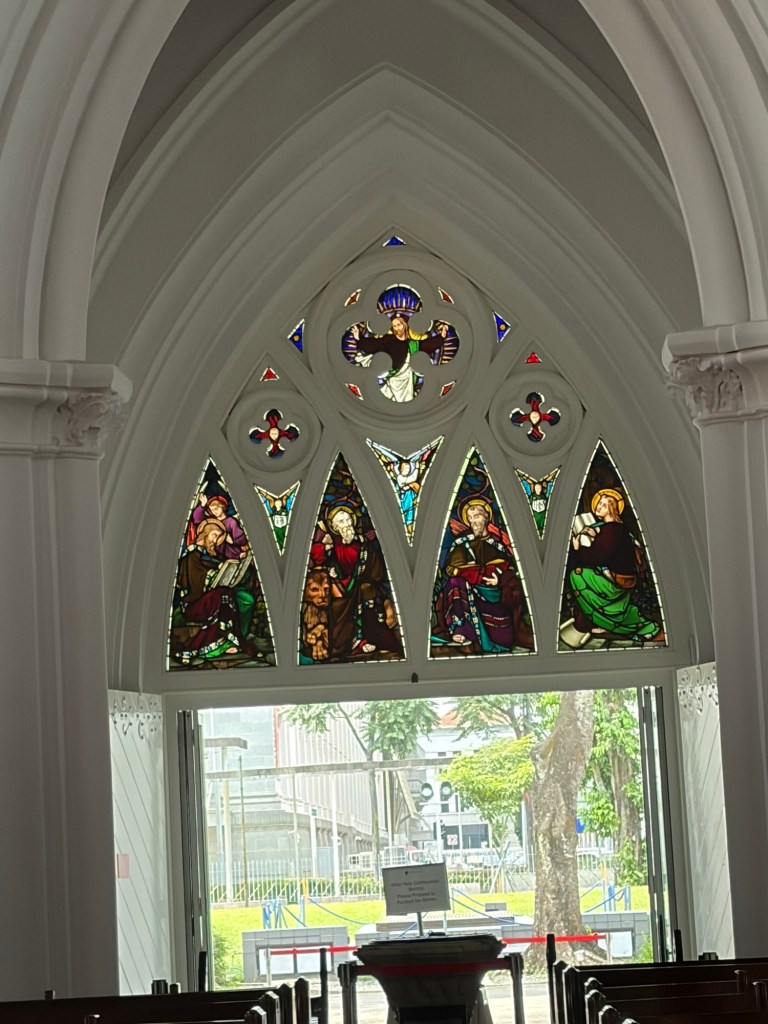
After a quick bathroom stop, we headed past the Esplanade Theatre and through a little park to our next destination, which was St. Andrew’s Cathedral. We had tried to visit this on our first day in Singapore in 2019 and found it closed due to refurbishment. This was high up my list of places to visit this time round. I had tried to find out about opening times ahead of time. There was nothing on their website and on another website, it stated that it is open Mondays to Saturdays from 08:00 to 20:00 apart from when it is not. This was not exactly helpful. We were lucky though and it was indeed open. It is quite a simple church, but it is very pretty. We sat down for a while to enjoy the peace of the cathedral. It was quite hot that day and the temperature in the cathedral was very pleasant. I had been handed a leaflet as we came in.
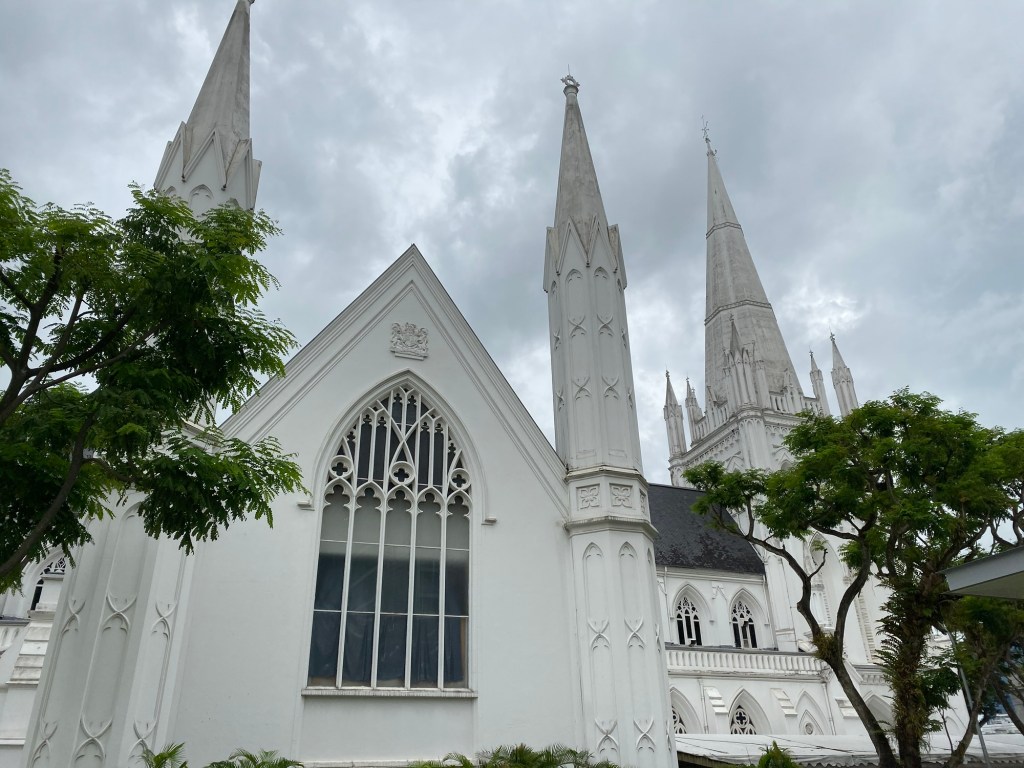
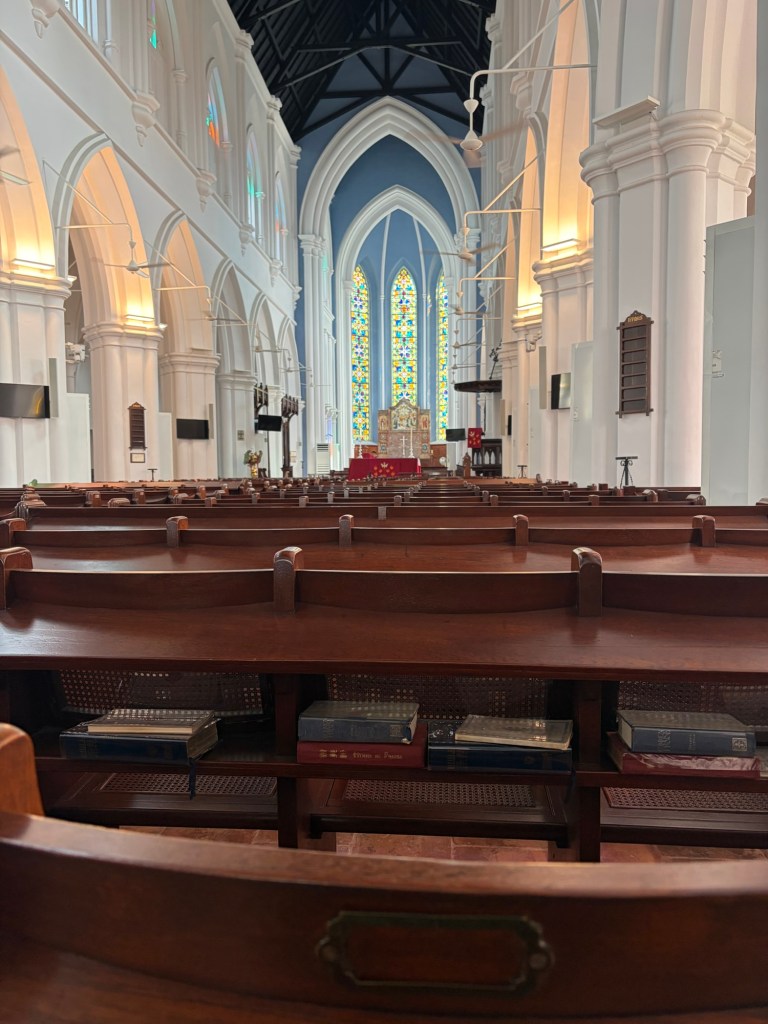
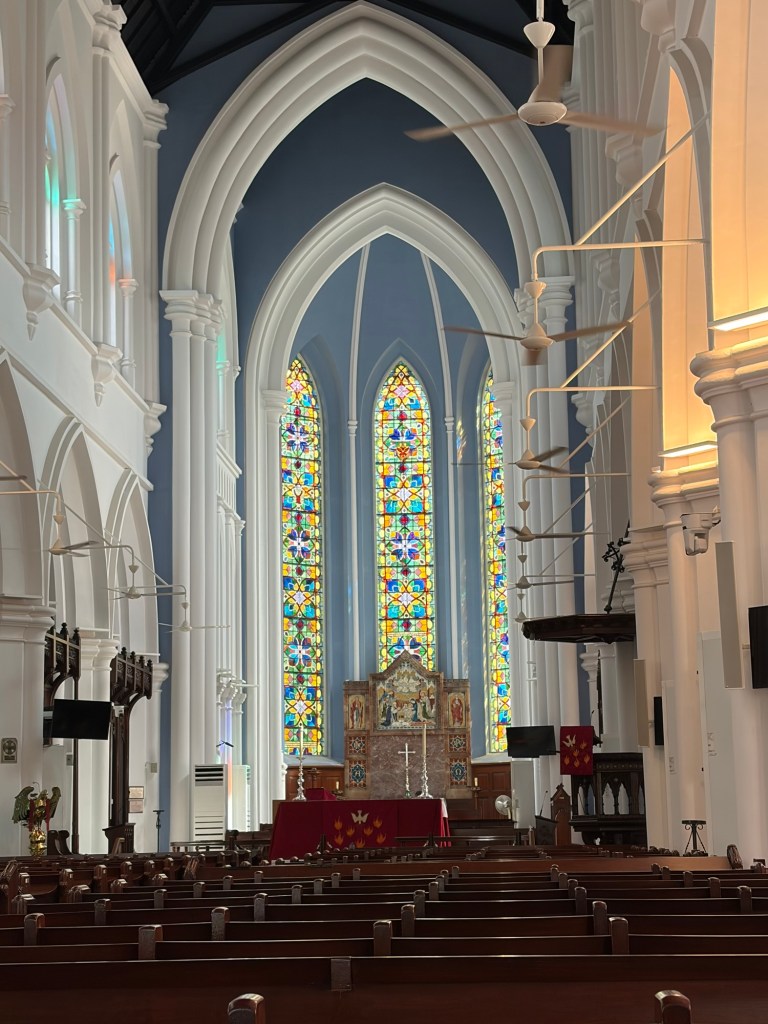
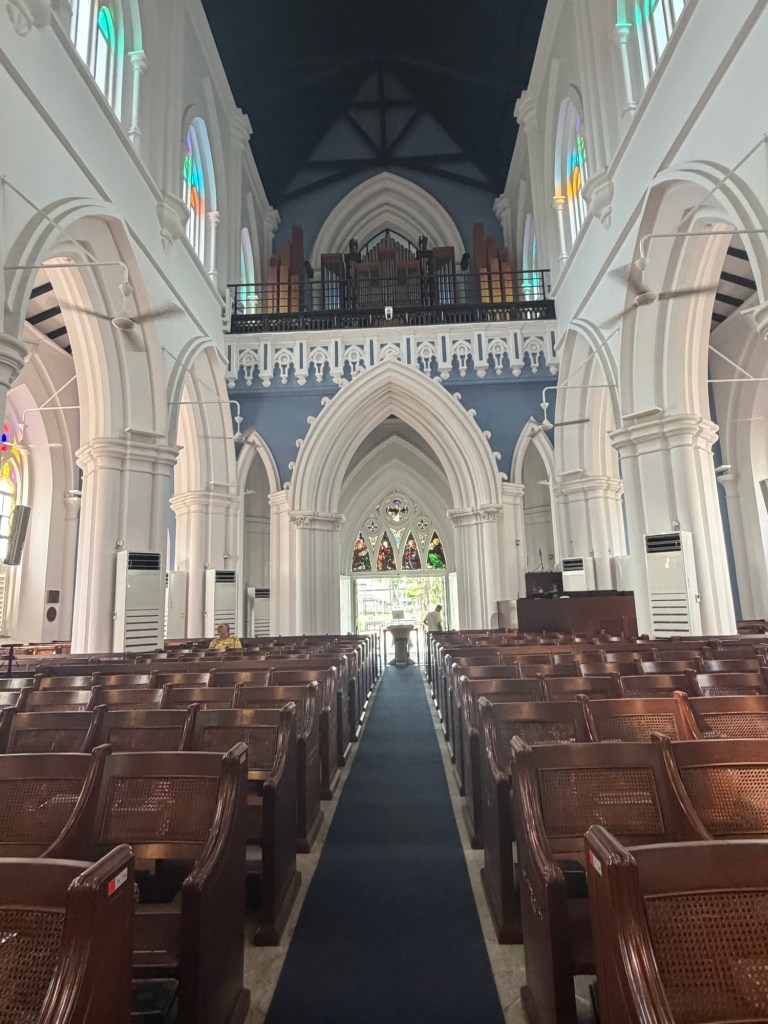
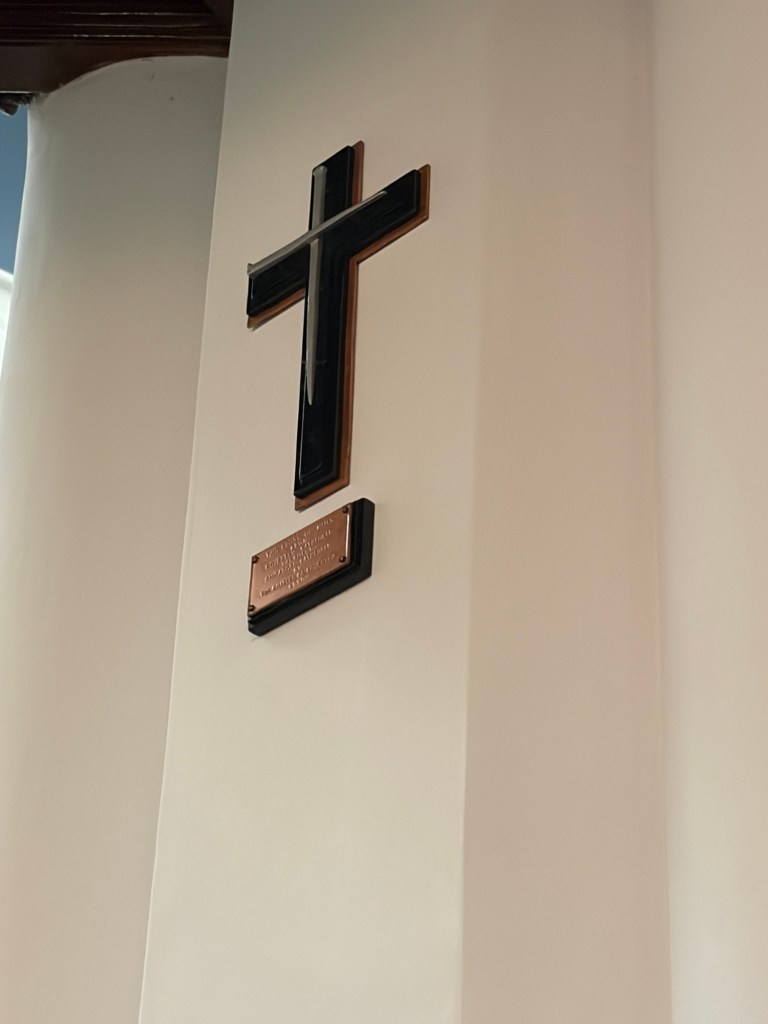
I decided to read this and found out that there was a cross of nails in the cathedral. The original cross of nails was made from three large medieval nails salvaged from Coventry Cathedral after the building was severely damaged by German bombs on 14 November 1940. Since then, replicas of the cross of nails have been given as gift to about 260 churches and organisations as a symbol of peace and reconciliation. I have been aware of this since my teens and have been lucky to see a few of them in different places over the years. I have always found this incredibly powerful. I was delighted to add another one to my list.
On our way out, we passed the new sanctuary. Around the start of the millennium, the congregation had outgrown the cathedral. As the cathedral is classified as a national monument, they could not extend it. Instead, a new sanctuary was built that is largely underground. I was pondering if I should check this out but decided against this. Instead, we headed for the local MRT station. We had no intention of going anywhere at that time, but the MRT station was also the MRT station for our next destination and this would keep us out of the sun for a bit. I was worth doing this for another reason, too. They had a lot of photos of historical buildings from around Singapore on the concourse with a short description for each of them. As both of us are interested in history, this was a nice bonus.
We ended up walking through shopping centre and decided to get something to drink. We ended up at a place that is specialising in soups and sandwiches, but they also had some other things. We had a lemon iced tea and a cranberry almond sourdough muffin each. This hit the spot. Then we headed back outside. I was amused when saw a German restaurant on the way. Normally I would have been all over this, but in Singapore I have other priorities when it comes to food.
As we came out of the shopping centre, I spotted something else interesting. There was a sign across the road that read CHIJMES. I was familiar with this name as this was the filming location for the wedding scene in Crazy Rich Asians. I asked Graham if he wanted to have a look and he was all for this. CHIJMES began life as a Catholic convent known as the Convent of the Holy Infant Jesus in 1852. The nuns had come from Penang to Singapore. Apart from the convent, there was an orphanage and a school for girls, which were both run by the nuns. CHIJMES was severely damaged by Japanese bombs in 1942. Following the bombing, forty nuns plus orphans and teachers were deported to a camp in Malaysia. The school was reopened under Japanese authority soon afterwards and the remaining nuns taught a Japanese curriculum. When Japan surrendered, the school resumed under its original name. In 1983, the school was relocated, and the land was purchased by the government of Singapore. The chapel was deconsecrated. Most of the old school buildings were demolished. What remained was designated a national monument in 1990. Most of the complex is now home to various retail, food and beverage outlets. The Caldwell House, which was the first building in the convent, is now a wedding venue. The chapel, which is now called CHIJMES Hall, is a function hall and wedding venue. They did a great job with this complex, and we enjoyed walking around. I would have loved to have a look at CHIJMES Hall, but this was closed. Apparently, it is normally open to the public “apart from when something is going on”. I hope that we will be able to catch it when it is open later this year.
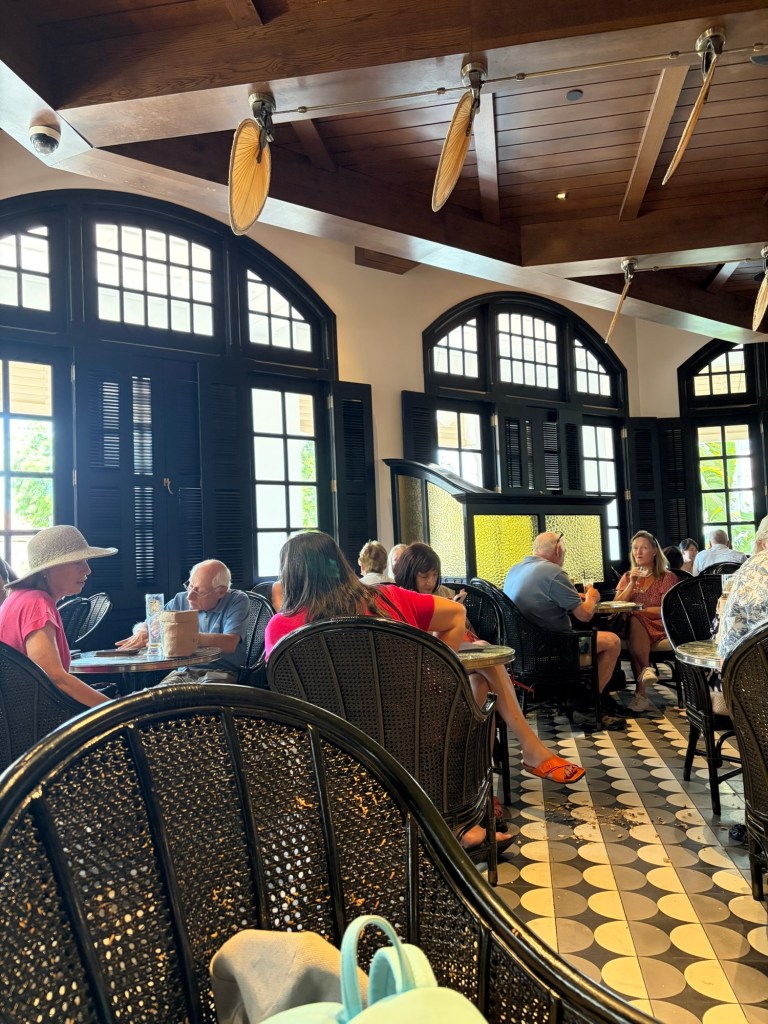
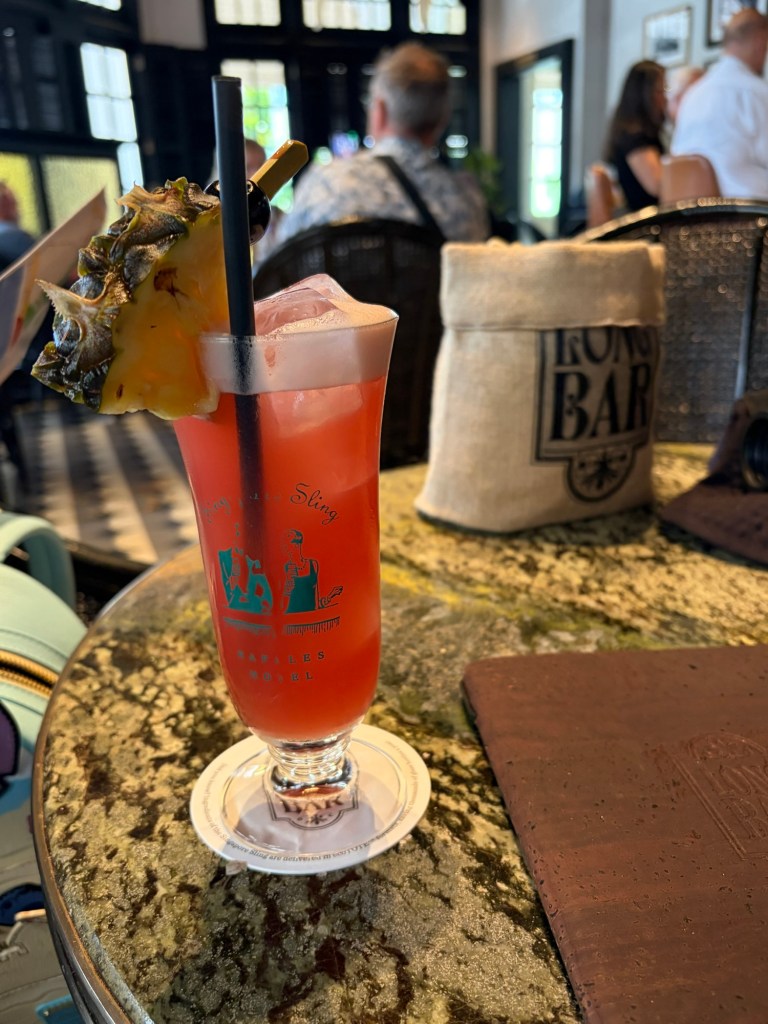
After this detour, we carried on to our planned destination, which was the Raffles Hotel and more specifically the Long Bar. The original Singapore Sling was created in 1915 by bartender Ngiam Tong Boon at the Raffles Hotel. The Raffles Hotel had long been famous for its gin slings at the time. However, at the time, etiquette dictated that only men could drink alcohol in public. Ngiam Tong Boon had the idea to create a cocktail that looked like a non-alcoholic fruit punch but had the kick of a gin sling. It took a while to perfect the recipe, but a version of the final recipe with some slight alterations is still served at the Long Bar at the Raffles Hotel to this day. Every time a new Raffles hotel opens somewhere in the world, a local signature version of the Singapore Sling is created. The next time I visit Dubai; I may have to try their version.
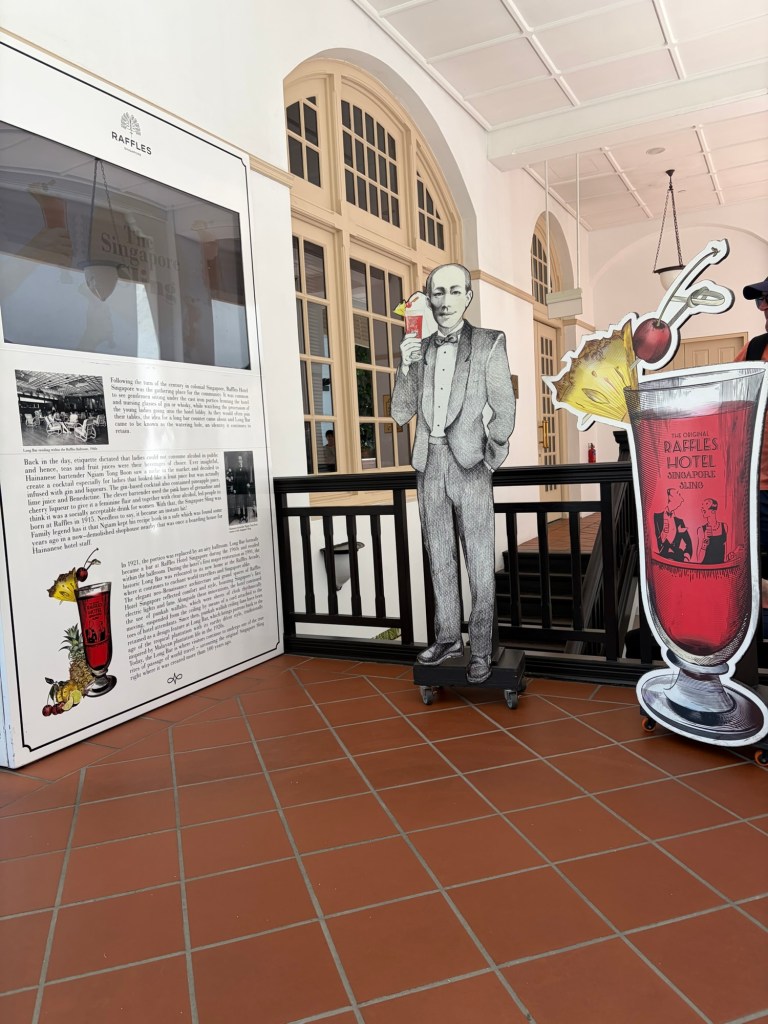
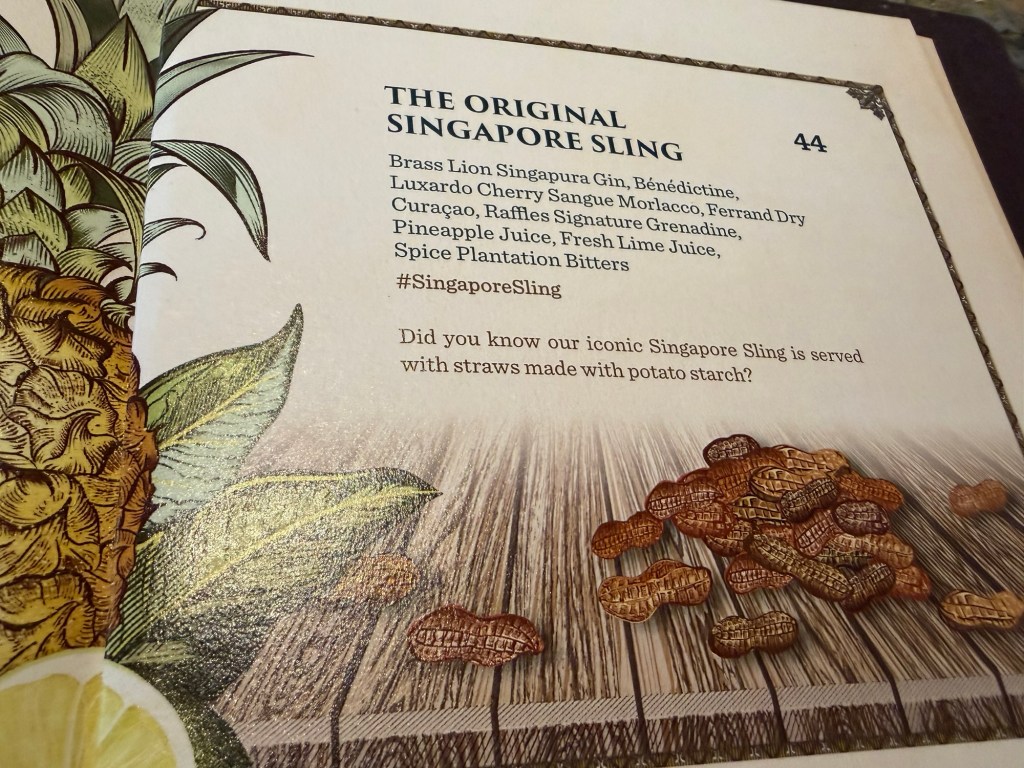
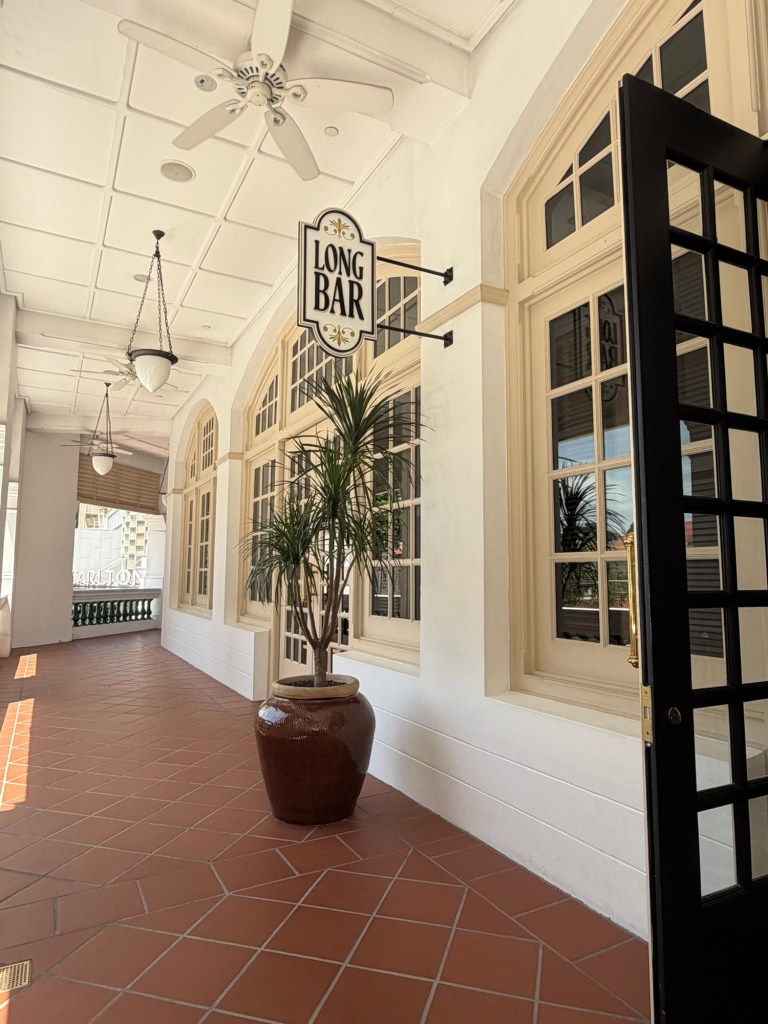
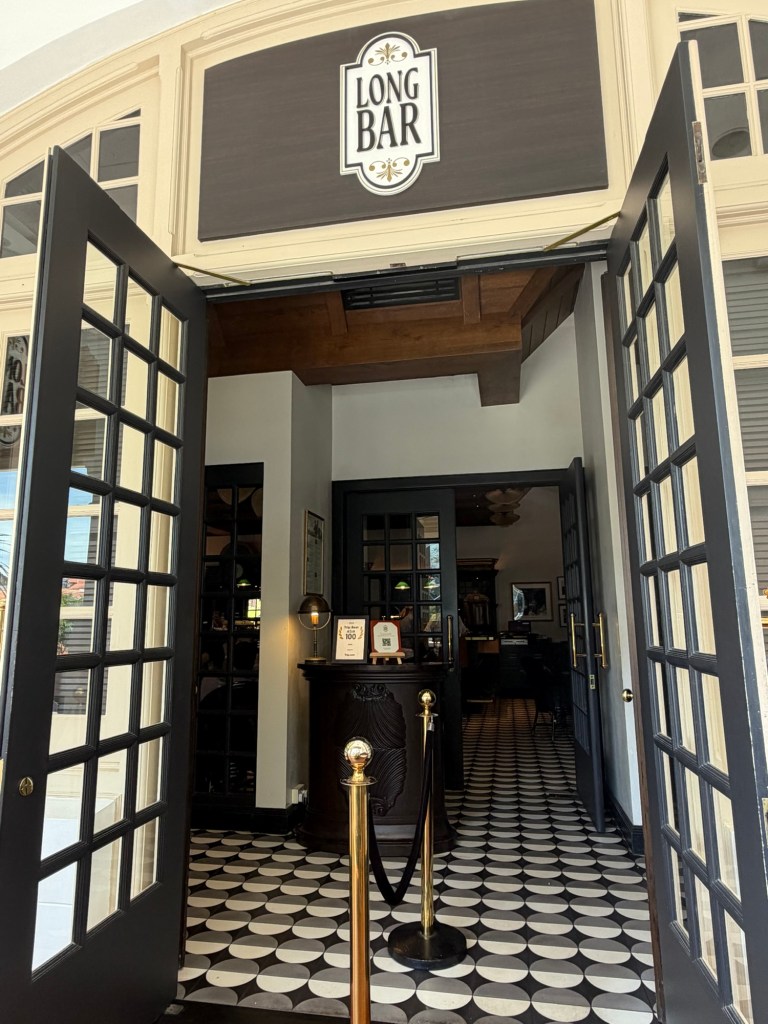
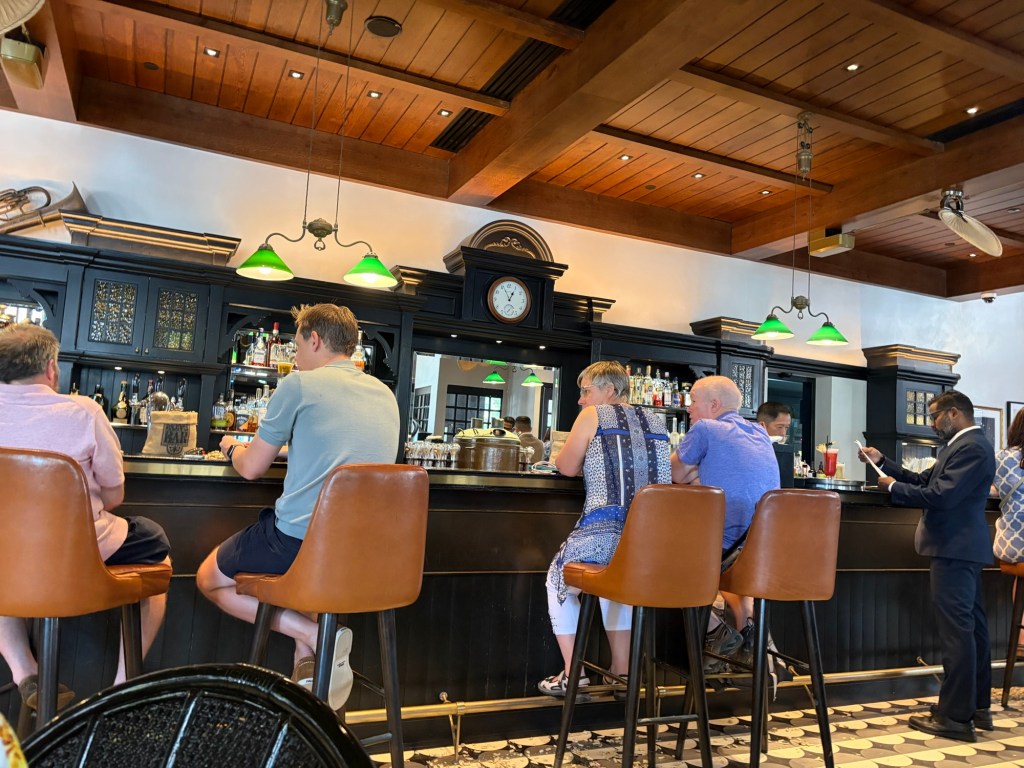
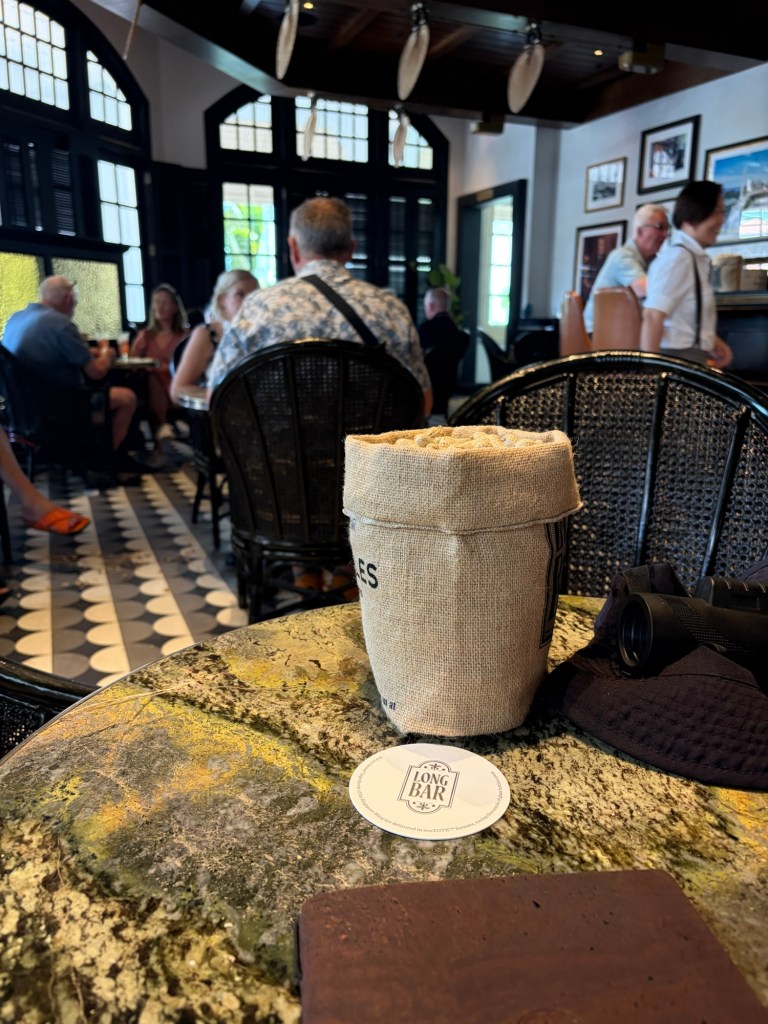
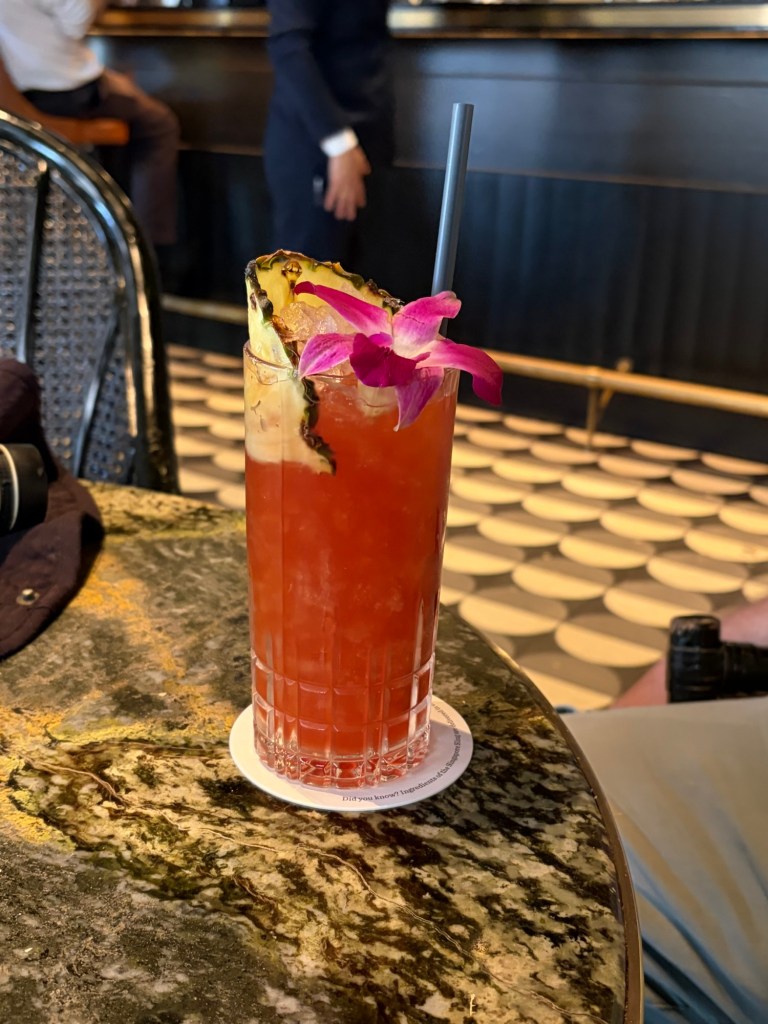
When we went in 2019, the line was crazy long, but we went on a Sunday afternoon. This time round, it did not look bad at all and after a short while, we were able to sit down on the benches outside the Long Bar to wait our turn. While we were waiting, we were given a small cup of iced hibiscus tea. This was delicious. I would happily pay for a glass of this. About 15 minutes after we arrived, it was our turn to be seated. The Long Bar is an impressive space and still has the original ceiling fans. They used to be operated by men. Nowadays they are electric. I had the original Singapore Sling. They have a few different versions, but I figured original is best. It did not disappoint either. Graham had a Planter’s Punch, which he also enjoyed. One thing that is strange at the Long Bar. Every table has a bag of peanuts in their shell. It is tradition to just throw the shells on the floor. Littering in Singapore is strictly forbidden and there are severe fines for littering and even for not clearing your table at a hawker centre. It is stranger that littering is not only not forbidden at the Long Bar but actively encouraged.
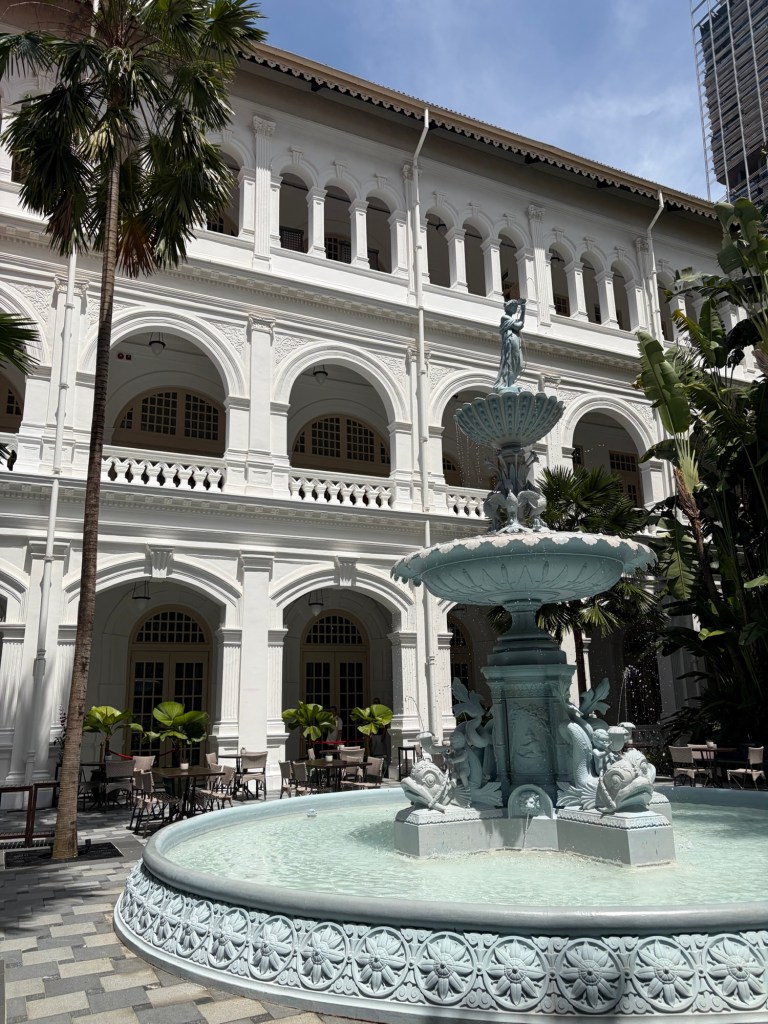
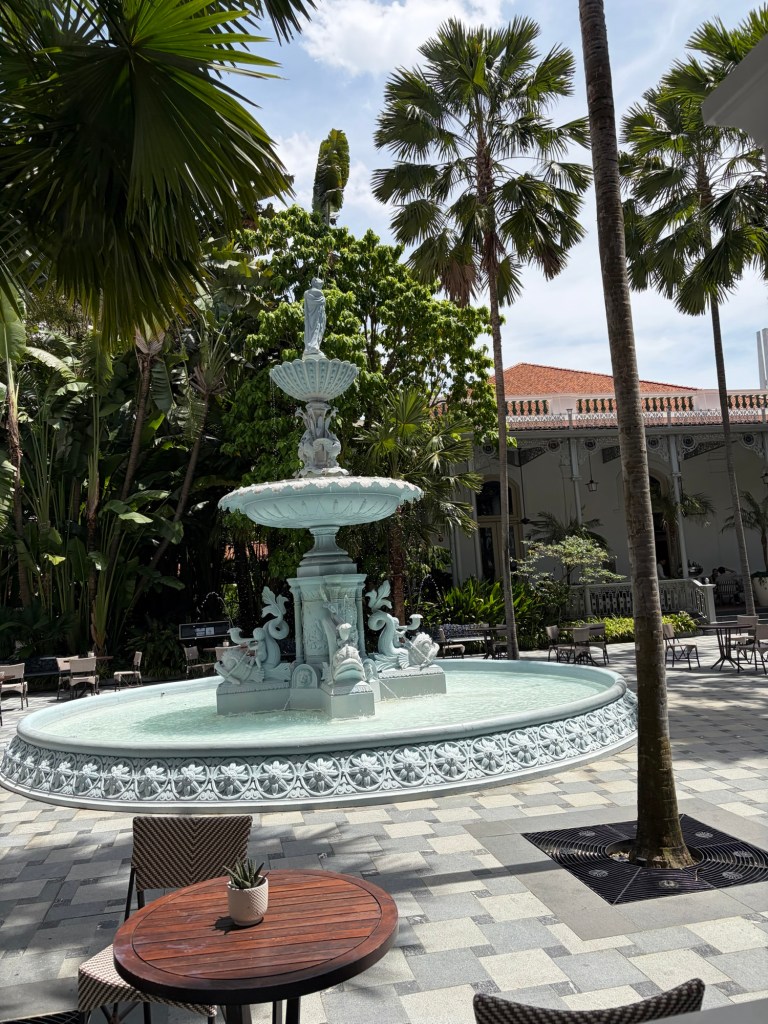
Once we had finished our drinks, we decided to check out the Raffles courtyard and the Raffles arcade. This is a beautiful area. We made our way right up to the main hotel entrance, but only hotel guests are allowed to enter the hotel. I would have loved to see the lobby as the Raffles hotel was built by the Sarkies brothers, who also built the Eastern and Oriental Hotel in Penang where we were due to stay later in the trip. Still, it was nice to just check out the areas we were allowed in. Graham used the bathroom in the Raffles arcade and recommended I do the same. It was a very nice bathroom, but not quite as spectacular as the bathrooms at Club 33 in Disneyland.
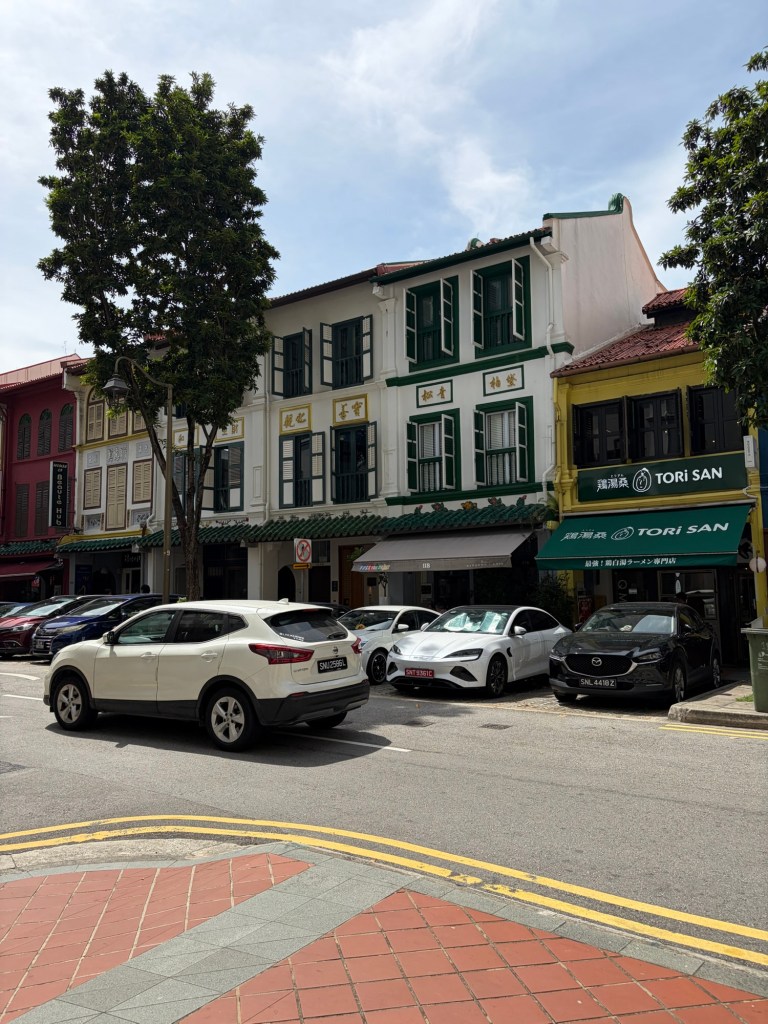
Once we had a good look around, we moved on to our next destination. This required taking to the MRT. The MRT station for the line we needed was only a short walk away and then it was only three stops. This landed us in the middle of Chinatown, and our next destination was just a short walk away. On the way, I took a photo of the beautiful shop houses in this area. However, our destination was Thian Hock Keng Temple. I had visited the temple in 2019 and really liked this. Graham had opted to sit in a nearby park at that time. This time he came to the temple with me but opted to sit on a ledge by one of the archways. I had only just entered the temple when Graham appeared behind me. He had been asked to move by one of the volunteers as according to their faith this particular archway is used by the gods to enter and leave the temple.
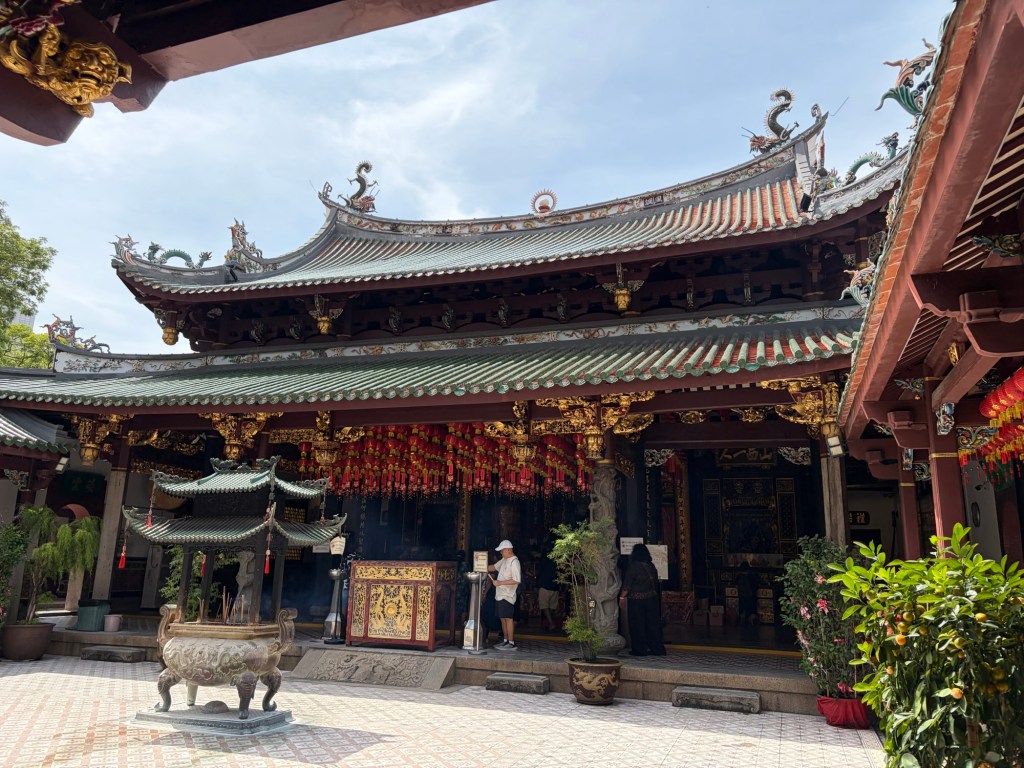
Thian Hock Keng is the oldest Chinese temple in Singapore. It is dedicated to Mazu, a Chinese sea goddess. When the temple was built, it was right on the waterfront, but following reclamation work, it is now a long way inland. On the face of it, Thian Hock Keng is a Taoist temple as it is dedicated to a god, and a number of different gods are represented in the temple. Buddhism does not have any deities. However, Taoism, Buddhism, Confucianism and Ancestral Worship are all represented in the temple. When we were there, the temple celebrated a three-day festival in honour of Guanyin. Guanyin is often referred to as the goddess of mercy, but the origin of Guanyin is actually in Buddhism where she is one of the enlightened beings. I knew a bit about Guanyin as Kek Lok Si in Penang has a huge Guanyin statue. However, I learned some new things. One of the volunteers approached us while we were having a look around and explained about the festival. He was impressed that when he referred to the goddess of mercy, I knew the name. He did ask me if I knew about the link between Guanyin and the brand Canon. I did not. Apparently, Canon is the Japanese name for Guanyin and the original logo for Canon featured a picture of Guanyin. As they say, every day is a school day.
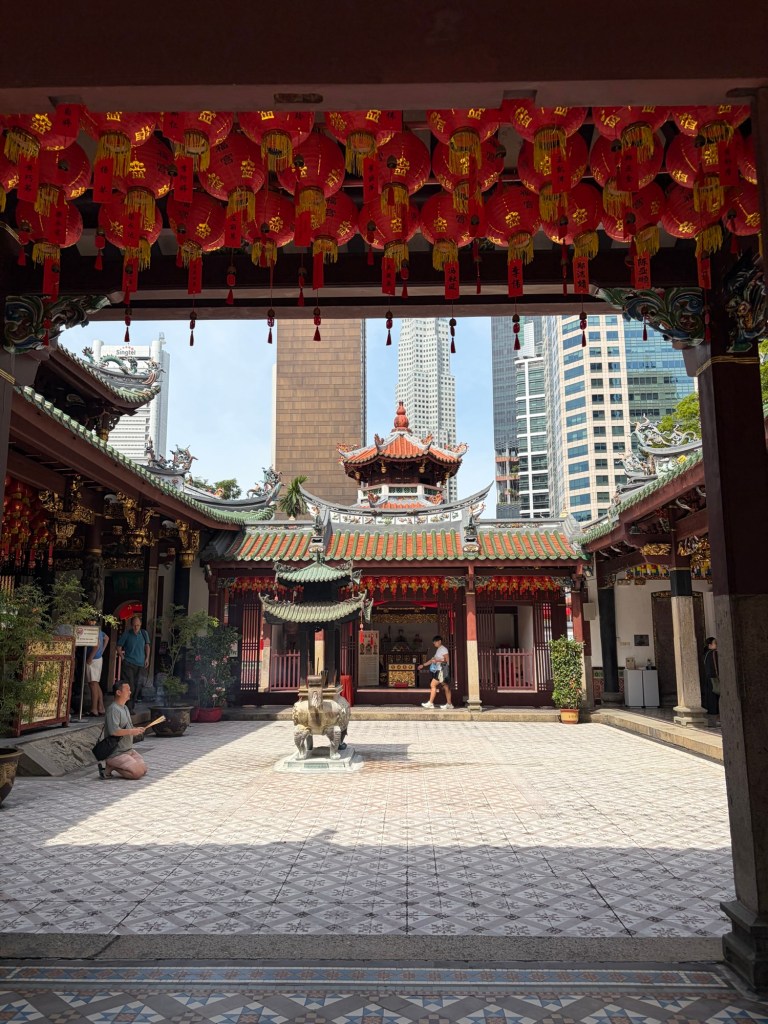
After we said goodbye to the volunteer, we continue through the rest of the temple and then exited to a beautiful pavilion with intricate stone carvings. There were benches there and we figured that it would be OK to sit down. However, when another volunteer approached us, we wondered if we were somewhere we should not be. However, he just thought we may be interested in our surroundings, which we were. The pavilion was traditionally used for lessons, and he pointed out various design elements of the pavilion and an adjacent roof to us and explained the meaning. Some of them, I was already familiar with, but a lot of this was new to me. I was glad that our visit to Thian Hock Keng coincided with the festival.
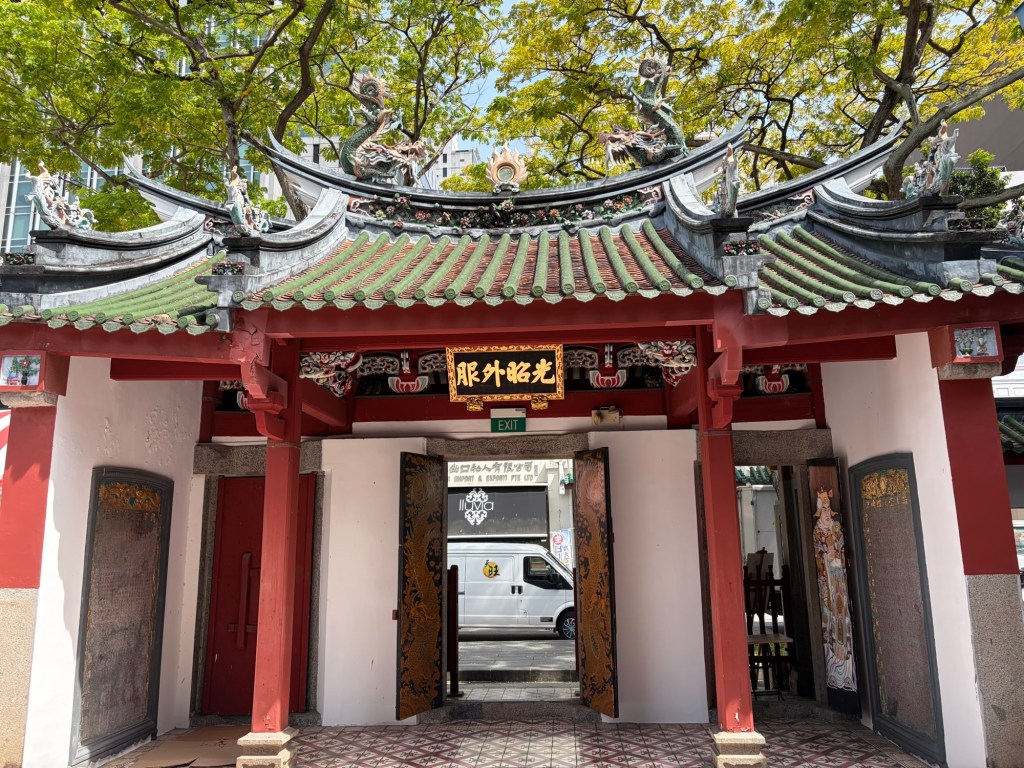
When we left, we spotted a café which is part of the temple complex. It is not unusual for temples in Southeast Asia to have a restaurant or cafeteria. This is where the Taoist heritage was quite clear. Buddhist temples offer vegetarian restaurants. This café served meat. We were however not in the market for food, but just something to drink. We both had a lemon iced tea. They had some cultural activity for children going on that involved making rice cakes. This was quite interesting to watch.
Once we had finished our drinks, we started to head towards another MRT station in Chinatown, which ultimately would take us back to our hotel. However, first there was the matter of dinner as a popular hawker centre is right next to the MRT station. We cut through Ann Siang Hill Park, which is located on one of the three hills beside the former Telok Ayer Bay. Once upon a time, it was home to nutmeg and cloves plantations, but today it is just a pretty park that offers some respite from the hustle and bustle of Chinatown. When we came out of the park, we went through a whole rabbit warren of side streets that ultimately led us where we wanted to go. Soon I saw the Buddha Tooth Relic Temple up ahead, which is opposite of where I wanted to be.
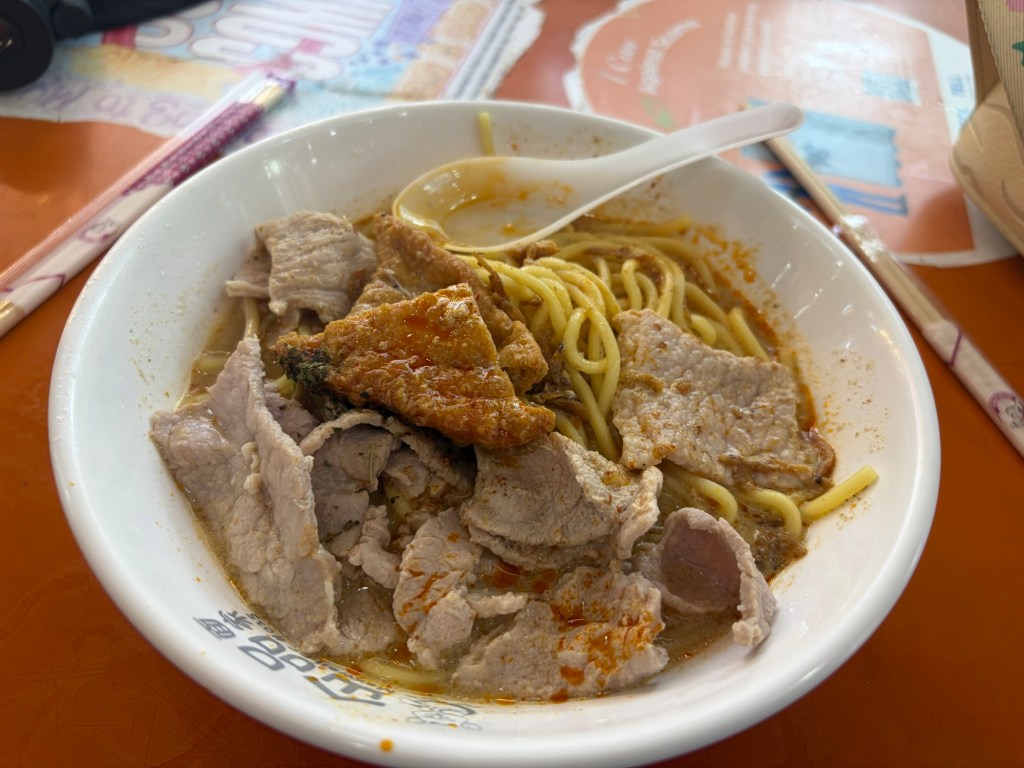
The Buddha Tooth Relic Temple was something else on my to do list. However, for this day I was done with sightseeing. Instead, we headed to the Maxwell hawker centre, which is opposite. This is much bigger than one we had been to a couple of days earlier, but only about half of the stalls were open. The choice was still overwhelming. In the end, we both had some Laksa, which is a curry noodle soup. Graham had his topped with fish and I had mine topped with pork. We both enjoyed this very much. We both had some honeydew melon juice.
Once we had finished our dinner, we headed next door to the MRT station to go back to the hotel. It was still quite early, but we were both tired. We both had a shower and then got ready for bed. It did not take long until we were both asleep.

 Dolphingirl’s Travels
Leave a comment